Paris Neighbourhoods: The Latin Quarter
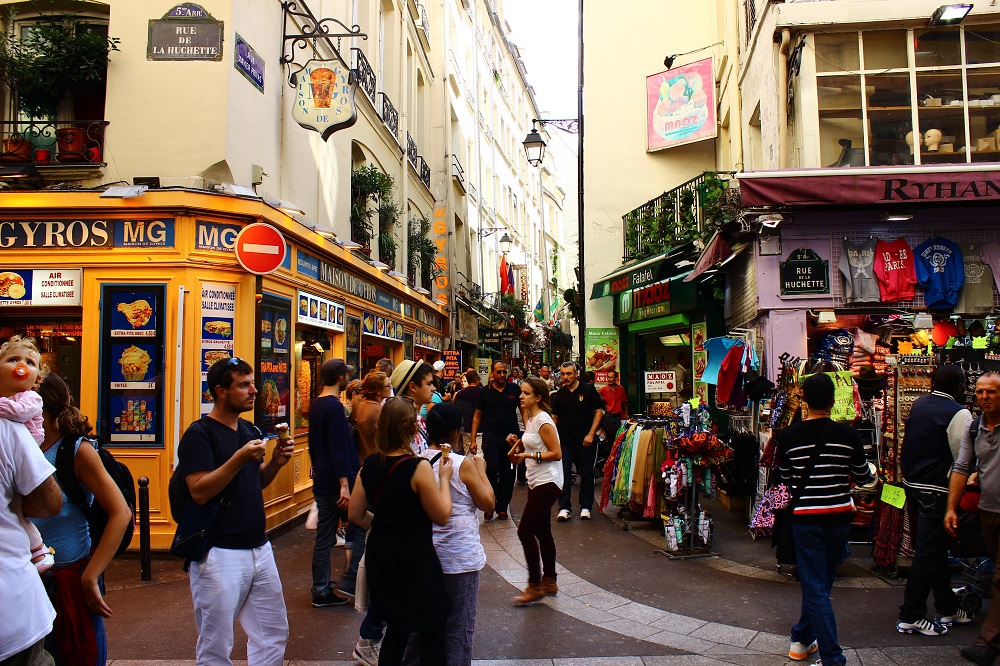
The Latin Quarter is the oldest surviving neighbourhood in Paris. It is also the most walkable. You can cover its main attractions in a single day without taking the Metro once. The real draw is not the famous monuments — it is the narrow streets, the second-hand bookshops, and the student cafes where a coffee costs €2 and lasts two hours.
This guide covers exactly what to see, where to eat on a budget, and how to avoid the tourist traps. I spent three days walking every block. Here is what matters.
Why the Latin Quarter Works for First-Time Visitors
The Latin Quarter sits on the Left Bank, directly across from Notre-Dame. Its street plan dates to Roman times. The Rue Saint-Jacques follows the old Roman road straight to the Seine. This layout makes it easy to navigate without a map: the river is always downhill.
Three things make this neighbourhood different from Montmartre or Le Marais.
- Density of history. The Cluny Museum (Musée de Cluny) holds the original Roman baths from the 1st century AD. The Pantheon sits on top of Montagne Sainte-Geneviève, the highest point on the Left Bank. You pass a 12th-century church every two blocks.
- Student energy. The Sorbonne university has been here since 1257. Over 100,000 students live in the area. This keeps prices lower than in Saint-Germain-des-Prés. A crêpe from a street vendor costs €4. A sit-down lunch menu runs €12-15.
- Walkable scale. From the Seine to the Jardin des Plantes is a 15-minute walk. From the Boulevard Saint-Michel to Rue Monge is 10 minutes. You do not need transport.
Skip the Latin Quarter if you want luxury shopping or nightclubs. Go to Le Marais for boutiques and Oberkampf for bars. The Latin Quarter is for walking, eating cheaply, and reading in parks.
The Three Must-See Spots (and How to Beat the Crowds)
Most visitors hit three places. Here is how to do each one without wasting time in lines.
Shakespeare and Company Bookshop
This English-language bookstore at 37 Rue de la Bûcherie opened in 1951. It is the successor to Sylvia Beach’s original shop that published James Joyce’s Ulysses. The current owner, George Whitman’s daughter, runs it.
Go at 9:30 AM, 30 minutes before opening. The queue forms fast. By 10:30 AM, expect a 20-minute wait. Inside, the shop has floor-to-ceiling shelves, a reading room with a piano, and a cat named Kitty. Buy a stamped book (€12-15) as a souvenir. Skip the photo line outside — you can take the same shot from the riverbank without waiting.
The Pantheon
Built as a church in 1757, now a mausoleum for French heroes. Voltaire, Rousseau, Victor Hugo, Marie Curie, and Alexandre Dumas are buried here. The Foucault pendulum hangs from the dome — the original demonstration of Earth’s rotation.
Entry costs €11.50. The crypt is the main draw. Allow 45 minutes. The view from the dome requires climbing 206 steps and costs an extra €3.50. Do it only on clear days. On hazy mornings, you see nothing but grey.
Rue Mouffetard Market Street
This cobblestone street has held a daily food market since the 16th century. The market stalls operate Tuesday to Sunday, 7 AM to 1 PM. After 2 PM, the street turns into bars and restaurants. Go in the morning for fresh produce, cheese, and rotisserie chicken. The best cheese shop is Fromagerie Beillevaire at number 90. Their Comté aged 24 months costs €15 per kilo — half the price of the same cheese in a supermarket.
Avoid the restaurants on the main strip. They serve frozen food to tourists. Walk two blocks east to Rue de l’Arbalète for Le Mouffetard, a proper bistro where a three-course lunch menu costs €16.
Where to Eat Without Spending €30
The Latin Quarter has more student restaurants than any other Paris neighbourhood. You do not need a reservation for most. Here is where locals eat.
| Restaurant | Address | Price for lunch menu | Best dish |
|---|---|---|---|
| Chez Gladines | 30 Rue des Cinq Diamants | €12.50 | Basque chicken with peppers |
| Le Petit Pontoise | 9 Rue de Pontoise | €18 | Steak frites with béarnaise |
| Crêperie des Arts | 27 Rue Saint-André des Arts | €8.50 | Galette complète (ham, egg, cheese) |
| Bouillon Racine | 3 Rue Racine | €16.90 | Boeuf bourguignon |
| Kebab de la Sorbonne | 13 Rue de la Sorbonne | €5.50 | Kebab sandwich with harissa |
Bouillon Racine is a 1906 Art Nouveau dining hall with tiled walls and brass fixtures. It seats 80 people. No reservations for lunch — arrive at 11:45 AM or wait 20 minutes. The Bouillon chain (there are six in Paris) keeps prices low by serving simple dishes in high volume. The food is good, not great. But at €16.90 for three courses, the value is unbeatable.
For a quick meal, the Rue de la Harpe kebab shops serve €5 sandwiches until 2 AM. The best is Kebab de la Sorbonne — they grill the meat on a charcoal flame, not a gas burner. The difference is noticeable.
The Roman Ruins You Walk Past Every Time
The Latin Quarter sits on top of Roman Lutetia. The Arènes de Lutèce is a 1st-century Roman amphitheatre hidden behind modern apartment blocks. Entrance is free. It sits at 47 Rue Monge. Most tourists walk past without noticing.
The arena held 15,000 spectators for gladiator fights and theatre. It was buried in the 4th century and rediscovered in 1869 during road construction. Today it is a public park. Locals play pétanque on the sand. Students sit on the stone steps reading. You can walk through in 10 minutes.
Combine this with the Cluny Museum (Musée de Cluny) at 6 Place Paul Painlevé. The museum contains the original Roman baths — the Frigidarium (cold room) has a 14-metre vaulted ceiling intact. Entry costs €12. The baths alone are worth the price. The museum also holds the Lady and the Unicorn tapestries, six 15th-century woven panels. Allow 90 minutes total.
Skip the guided audio tour. The museum’s free paper guide is better — it has a map of the Roman city superimposed on modern streets. You can trace the old Roman wall while walking outside.
When the Latin Quarter Fails: Common Mistakes
I made most of these mistakes on my first visit. Here is what goes wrong and how to avoid it.
Mistake 1: Eating on the Boulevard Saint-Michel. The restaurants on this main boulevard pay high rent. They charge €20 for a pizza that costs €8 two blocks away. Walk one street east or west. The difference in price and quality is immediate.
Mistake 2: Visiting the Pantheon at noon. The queue wraps around the building. Go at 10 AM or 3 PM. Tuesday and Wednesday are the quietest days. Sunday is the busiest because of free entry to the crypt for EU residents under 26.
Mistake 3: Assuming all bookshops are Shakespeare and Company. The Librairie Julliard at 30 Rue Saint-Jacques has been open since 1880. It sells second-hand French literature for €3-5. The Abbey Bookshop at 29 Rue de la Parcheminerie is a Canadian-run English bookshop with a basement reading room. Both are quieter and cheaper than Shakespeare and Company.
Mistake 4: Taking a taxi. The Latin Quarter has narrow one-way streets. A taxi from the Pantheon to the Jardin des Plantes takes 15 minutes and costs €10. Walking takes 12 minutes. The only time you need transport is if you have luggage or limited mobility. In that case, take the Metro line 10 from Cardinal Lemoine to Jussieu — two stops, €2.10.
Mistake 5: Forgetting the Jardin des Plantes. This 24-hectare botanical garden at the eastern edge of the quarter is free. The Ménagerie (zoo) costs €13. The Grande Galerie de l’Évolution natural history museum costs €12. The garden itself is worth an hour of walking. It has a rose garden, alpine garden, and the oldest tree in Paris — a locust tree planted in 1601.
Latin Quarter vs. Other Left Bank Neighbourhoods
The Latin Quarter overlaps with Saint-Germain-des-Prés and the 5th arrondissement. Here is how they compare for a visitor.
Saint-Germain-des-Prés is west of the Latin Quarter. It has the same historic cafes (Café de Flore, Les Deux Magots) but costs twice as much. A coffee at Café de Flore costs €7.50. The same coffee at a Latin Quarter cafe costs €2.50. The difference is the brand name. Saint-Germain is for people who want to say they sat where Sartre sat. The Latin Quarter is for people who want to sit.
The 5th arrondissement extends south past the Pantheon into residential streets. This is where the Sorbonne students live. It has fewer attractions but cheaper restaurants. The Rue de la Montagne Sainte-Geneviève has the best kebab shops and falafel stands in the quarter. A falafel sandwich at L’As du Fallafel (24 Rue de la Montagne Sainte-Geneviève) costs €7.50 and is better than the famous one in the Marais.
For a quiet evening, walk to the Square René Viviani behind Notre-Dame. It has the oldest tree in Paris — a black locust planted in 1601. The bench facing the cathedral is free. Most tourists do not know it exists.
If you have two days in the Latin Quarter, spend the first day on the main sights (Pantheon, Cluny, Rue Mouffetard) and the second day exploring the side streets between Rue Monge and Rue des Écoles. That block contains the Institut du Monde Arabe with its mechanical window shutters (free entry to the ground floor) and the Place de la Contrescarpe fountain square where Hemingway lived in 1922.
The Latin Quarter rewards slow walking. The best discovery I made was a tiny courtyard at 15 Rue de la Sorbonne with a 13th-century well and a wisteria vine. No sign marks it. You just have to open the door.